Over at IHE, Eric Sickler uses Valentine's Day to illustrate his suggestions for a strong recruitment plan:

Let’s start by channeling Maslow.

Humans want to feel the love. It’s right in the middle of that colorful pyramid. We all yearn to belong; we all want to feel wanted. Arguably, a young adult’s need for it is on overdrive.

Great recruiters routinely show love to their recruits by lavishing them with lots of attention, by sharing especially relevant and resonant information, and by making each one feel as though s/he is at the top of the prospective student V.I.P. list.

Technology now allows us to really pile on the love by sending “personalized” messages via every imaginable channel, each remarkably tailored to the recipient’s peculiar interests.

But the most influential of all “love gifts” that colleges and universities show prospective students comes in the form of scholarships and grants. Free money. Deep discounts. Great deals. All designed to help the recruits we love conquer what they view as the ridiculously high price of higher education.

[...]

Other than gift aid, what valuable symbols of affection can your institution offer students you want most? Here’s a handful of thought-starters:

  • Priority/preferred registration.
  • Priority/preferred housing or parking assignments.
  • Athletic coach-like attention from music/theatre directors, student group leaders and sponsors, and other co-curricular personalities who are engaged in activities of interest to the prospective student.
  • For new students with children, priority placement or discounted day care services.
  • Assignment of a “career mentor” (an alumnus/a working in the student’s intended career field).
  • Assignment of a “peer mentor” (college junior) who will be a senior when the prospective enrolls as a freshman.
  • Assignment of a “peer family” (family of current student or recent grad) to provide unofficial, on-demand trusted counsel to incoming freshmen parents.
  • Local host family assignment to offer first-year students a home-away-from-home.
  • Academic advising/consulting during high school senior year.
  • Multichannel outreach/attention (webinars, text messaging, social media initiatives, correspondence, event hosting, high school or home visits, etc.) by the student’s major professor or department chair.

Unorthodox thinking? Yes, by traditional recruitment standards. But to borrow (and butcher) an old saw, “Different times really do call for different measures.” It’s looking like that time is now.

Okay. So to start, dude used Maslow as an example (psychology/student affairs nerds like me will know what that means). Awesome.

But he's right; people want to feel loved. And, how else can we in the recruitment space show more love than to give students money to attend our institution.

However, I'm sure that I'm not the only admissions professional, nay, higher education professional that continues to see shrinking budgets and overzealous financial offices looking to scrutinize every penny that is spent. So, since offering students more money isn't an option, let's look at the "symbols of affection" that Mr. Sickler recommends.

While these ideas certainly are 'out of the box' thinking, I would want to be cautious. I have to take issue with the first two in particular. Offering a student priority registration or priority housing or parking could be a violation of the National Association for College Admission Counseling's Code of Ethics and Professional Practices (formerly known as the Statement of Principles & Good Practice or SPGP):

Colleges must not establish policies, engage in practices,
imply advantage, or offer incentives whose effect is to
circumvent NACAC’s Code of Ethics and Professional
Practices’ established deadlines. Incentives are allowed
when equally available to students who wait until the
established deadlines. Colleges will not guarantee
admission, specific college placement, or institutional
financial aid or scholarship awards prior to an application
being submitted, except when preexisting criteria are
stated in official publications.

...and offering incentives like parking, housing, or priority registration could be risky and put an institution out of compliance with NACAC's policies.

The other ideas, however, are more sound, if not for recruitment - for all students on campus. So long as you aren't playing favorites and providing the same services for everyone on campus, then the list that Sickler posits contains some great ideas.

Read More …

Categories: ,

Old Main, on Penn State's University Park campus
According to a recent article at Bloomberg, we are seeing fewer students taking advantage of higher education in the United States:

New foreign student enrollment in the U.S. dropped by 6.6 percent in the 2017-18 academic year, double the previous year’s rate of decline, according to the Institute of International Education (IIE). While the total number of international students in the U.S. grew slightly, the drop in new enrollees is the biggest since 9/11, said Rachel Banks, public policy director at NAFSA: Association of International Educators. The decline seems to be continuing this year, she said.

The report attributed the drop to multiple factors, including visa delays and denials, the “social and political” environment and the cost of attending a U.S. school. The administration’s hard-right immigration policies, such as banning people from Muslim-majority countries and separating children from their parents at the border, make prospective students and their parents feel “that we’re not a welcoming country,” Banks said.

The number of F-1 visas, the kind issued to foreign students going to school full-time in the U.S., dropped from about 644,000 in fiscal 2015 to about 394,000 in fiscal 2017, according to data from the U.S. State Department. Vanessa Andrade, associate director of international partnerships and program development at California State University, Northridge, said safety is always the biggest concern.

I'm not trying to get too political on you, but there is certainly a correlation between the Trump administration's rhetoric and the downward trend in international enrollments at colleges and university in the United States. I'm guessing that many people don't realize that other countries are major consumers of higher education in our country:

The more than 1 million foreign students in the U.S. contributed $39 billion and supported more than 455,000 jobs during the 2017-18 academic year, according to an analysis by NAFSA. The largest spending benefits went to California, New York, Massachusetts, Texas and Pennsylvania. NAFSA said education is one of the country’s biggest services exports.

“Education—particularly higher education—is a major American export,” University of California, Santa Barbara economics professor Dick Startz wrote in a Brookings Institution blog post in 2017. “When we provide a service that leads to foreigners sending money into the U.S., that’s an export with exactly the same economic effects as when we sell soybeans or coal abroad.”

So this is going to quickly become an economic issue as much as it is a diplomatic one.

And, like with domestic recruitment, institutions of higher education will be recruiting from a dwindling pool of international students.

Read More …


A college friend sent this to me on the Faceblast. My day, made.
Read More …


A college friend sent this to me on the Faceblast. My day, made.
Read More …

(Subtitled: Don't Ask Questions About Another School)


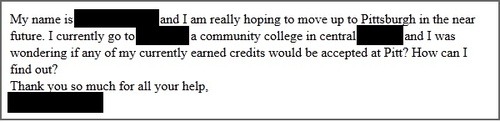
Hello [REDACTED], and thank you for your email!
While I can certainly appreciate your interest in Pitt, as it is one of Pennsylvania’s fantastic state-related institutions of higher education, you have sent this email message to Penn State.
As it happens, I do specialize in assisting transfer students with the processing of their application for admission (to Penn State), and the evaluation of their transferable credit. However, it is extremely difficult for me to assess how a different institution might evaluate your transfer credits from [REDACTED] Community College.
If you transfer to Pitt and find that you are unhappy there, please feel free to reach out if you become interested in Penn State. We actually have three campuses near Pittsburgh!
Cheers,
Admissions Dude
PS: Pittsburgh is a fantastic city. Be sure to check out the South Side. My band used to play on Wednesday nights at Nick’s Fat City (which is now apparently the “Diesel” club and restaurant). Also check out Carson Street Deli, which is home to an excellent Italian sub.
Read More …

Categories: , , ,

Indeed they do.
After a couple of admissions cycles, some will move on to something else, while others will get sucked into the higher education industry for the rest of their careers.
“A co-worker of mine once described admissions as a two-or-20 job, meaning you’re either in it for two years or 20 years,” said Matthew Kaberline, who used to work in UMW admissions and recently became the associate director of college counseling at the Severn School in Maryland. “There didn’t seem to be an in between.”
The centerpiece of the job is “travel season,” which runs from September to early November. Recruiters hit the suburbs with color-coded calendars and global positioning systems loaded with high school addresses. They rack up loyalty program points at mid-tier hotels, log thousands of miles on rental cars and learn how to hide booze on their expense reports.
Between appointments, they wander through shopping malls, search for a Panera with WiFi or dream about how they will someday blow all of these loyalty points on a major vacation. Many of these road warriors become friends. Some drunkenly hook up. A few fall in love.
But the lifestyle can be exhausting. The pay can be painfully low. And it can be frustrating for some recruiters, who are figuring out their lives, to deal with high school students who are doing the same thing.
A couple of points on this:
1) I was always told that admissions is a “3-or-30 career”.  You’re in it for 3 years then on to something else (usually high school guidance counseling), or you’re in it for 30 years prior to retirement.  I’m working on 10-plus and counting – with no sign of departure.
Apparently, I’ve been “sucked” into higher education.
2) I don’t know if I would agree that travel season is the “centerpiece” of the admissions recruiter’s year. But, it is definitely a big part of it. 
Back in my travel days, we didn’t have GPS in every car. But, we did “rack-up” the miles in rental cars and “rewards points” at the big hotel chains. No comment on the booze…
[Yeah. That’s me and my babyface, circa 2001 – at the height of my travel glory days.]
3) I made quite a few lasting friends on the road, but I’m proud to say that I never “hooked up” with anyone while traveling (except for my wife who once surprised me at the Atlantic City NACAC National fair by showing up at my hotel).
I do remember the days of being a “road warrior” with a strange fondness. Granted, it was a royal pain for my family life.  Unlike many of the “20-somethings” that the article talks about, when I was in my early career I was already married and starting a family.  I made every effort to do “out-and-back” visits (as opposed to “overnighters”), but inevitably I would be away from my wife and young child two, three or four nights-per-week.
That said, despite feelings of (extreme) guilt, I did have fun on the road.
Nowadays, I consider myself fortunate to work in a college admissions job that requires almost no recruitment travel.  Oh sure, I visit a few local high schools, occasionally visit other Penn State campuses around the Commonwealth, and of course I attend professional development conferences/conventions.  But gone are the days of the “road warrior”. 
All of that said, I think that I am still finding my own future.  You don’t have to be a “20-something” to be continually searching for what you “want to be when you grow up”. 
Read More …


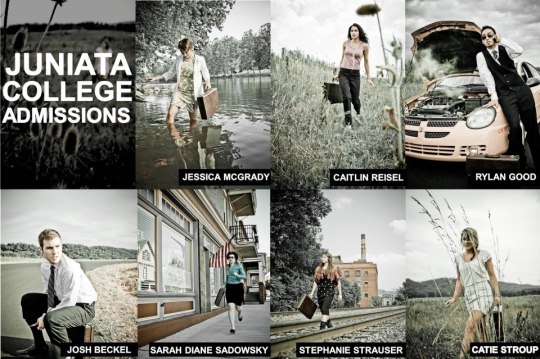
As an Admissions Dude, I’d be remiss if I didn’t highlight this great piece of admissions travel propaganda. 
Here we have the traveling counselors from the Juniata College admissions crüe in something of a 1970s, “Mod Squad”-esque pictorial. The photos were all taken by 2012 Juniata graduate Patrick McCloskey.
The image is found at the Juniata College Admission Facebook page – where they (smartly) link to their travel schedule for the fall season. 
I find myself wishing that my admissions office looked this cool…
Read More …